The report
The full findings, with every table, denominator and caveat, the action plan and the data gaps. Use it when you need to cite a number or check a claim.
The Legal Access Report, September 2026
We asked 47 formerly incarcerated people whether, while in Connecticut custody, they could find the law, get their court papers, mail a filing and reach legal help. This page explains what they reported, how to read every number, and what should happen next.
9of 31
said their Connecticut facility had a law library
5of 31
visited one and found books there
0of 31
reported a printer or computerized legal research there
Legal Access in Connecticut Correctional Settings
The survey asked about every step between having a legal problem and doing something about it: law libraries, legal research, court documents, legal mail and supplies, talking with other people about legal matters, and the Inmate Legal Assistance Program (ILAP), the program meant to give people in Connecticut custody legal help.
What came back was a pattern. People described access that existed on paper but was hard to use in practice, and a system that often ran on family money, outside help and what other incarcerated people knew.
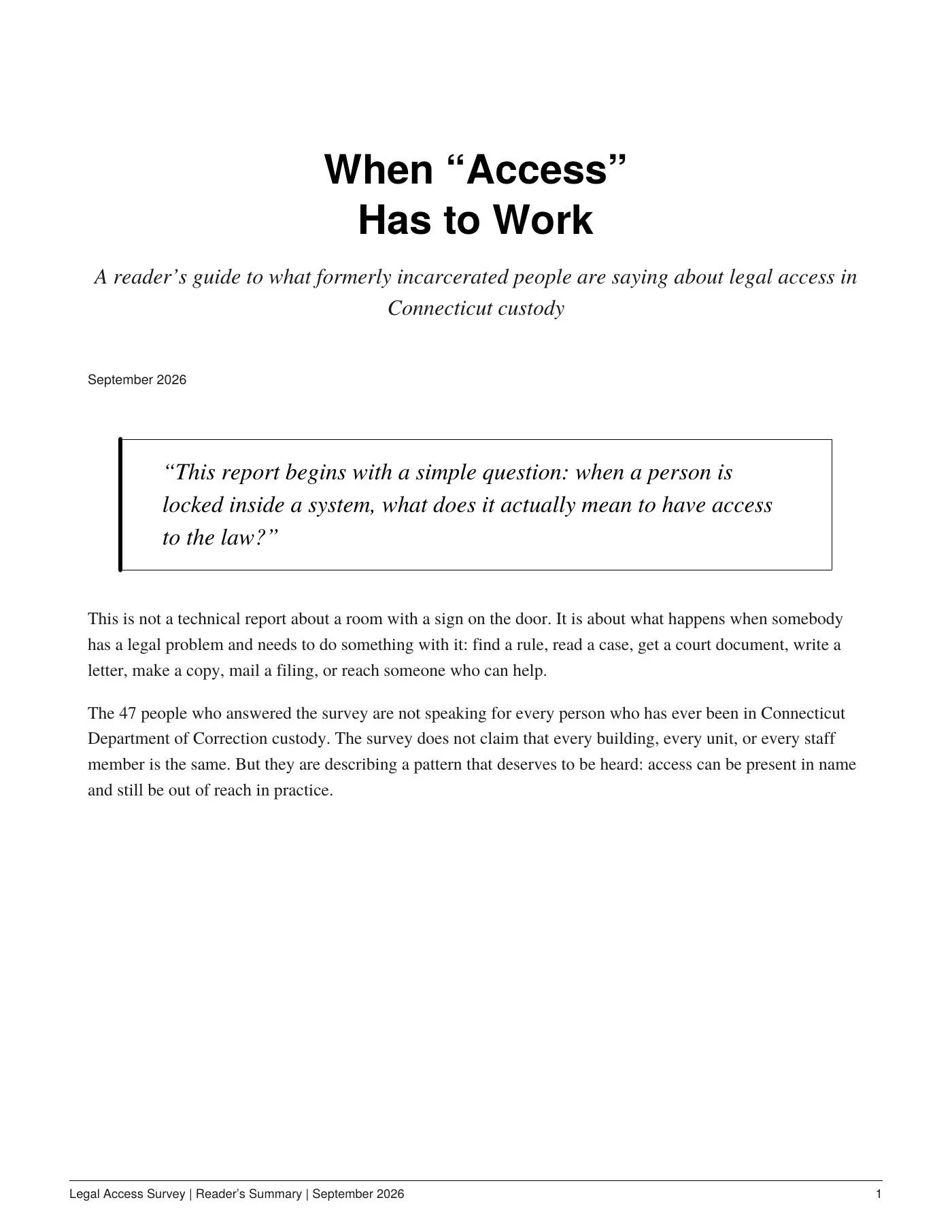
The report presents what participants reported. It is meant to inform administrative review, further fact-finding, policy and public discussion. It does not claim to measure conditions statewide or to prove that any law or policy was broken.
Six rules the report follows
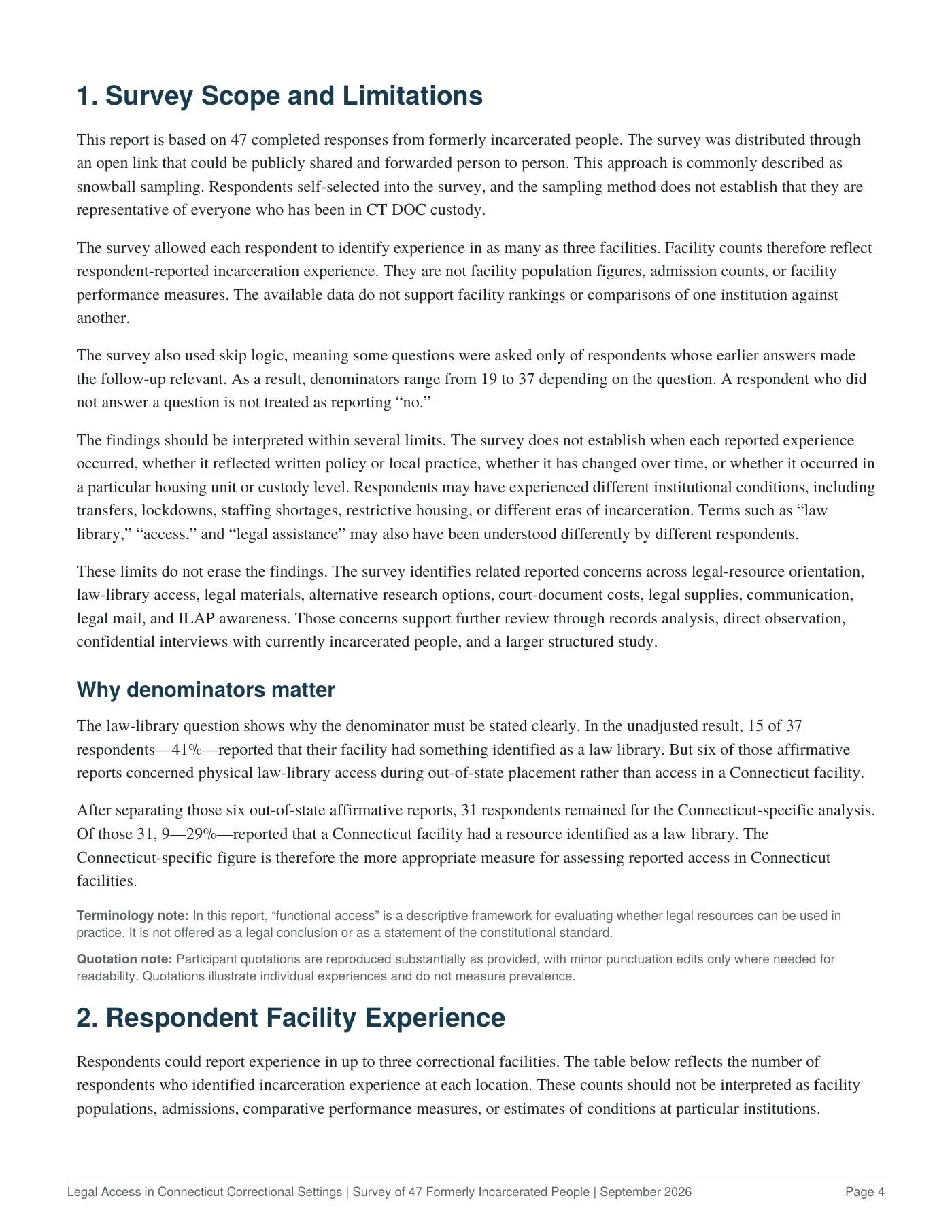
Not everyone answered every question. The survey used skip logic, so follow-up questions went only to people they applied to. Each percentage is out of the people who answered that question, from 19 to 37 people.
When someone did not answer, the report treats it as missing information, never as a negative answer.
Six people described law libraries they used while placed in facilities outside Connecticut. Counting them would turn 9 of 31 into 15 of 37. The report separates them so out-of-state access does not inflate Connecticut's.
People chose to take the survey through a link that was shared from person to person. That is useful for finding problems, but it cannot say how common a problem is across every facility, or whether it is still happening today.
The facility list shows where respondents had been held. It is not a facility population, an admission count or a score, and it cannot be used to compare one prison with another.
Participant quotes are reproduced substantially as written. They show what a barrier is like, not how often it happens. "Functional access" is the report's way of describing usable access, not a legal standard.
Choose a finding to see it in boxes
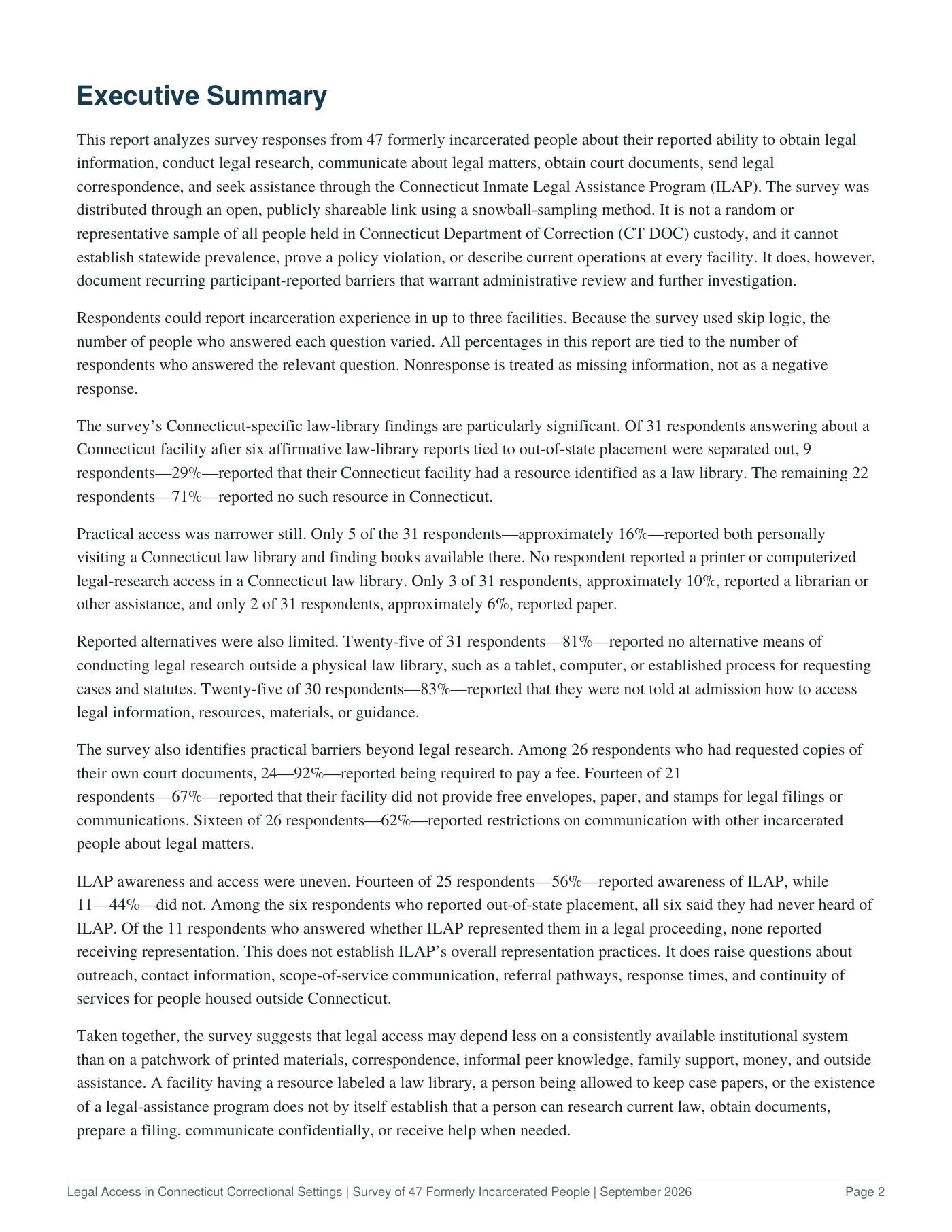
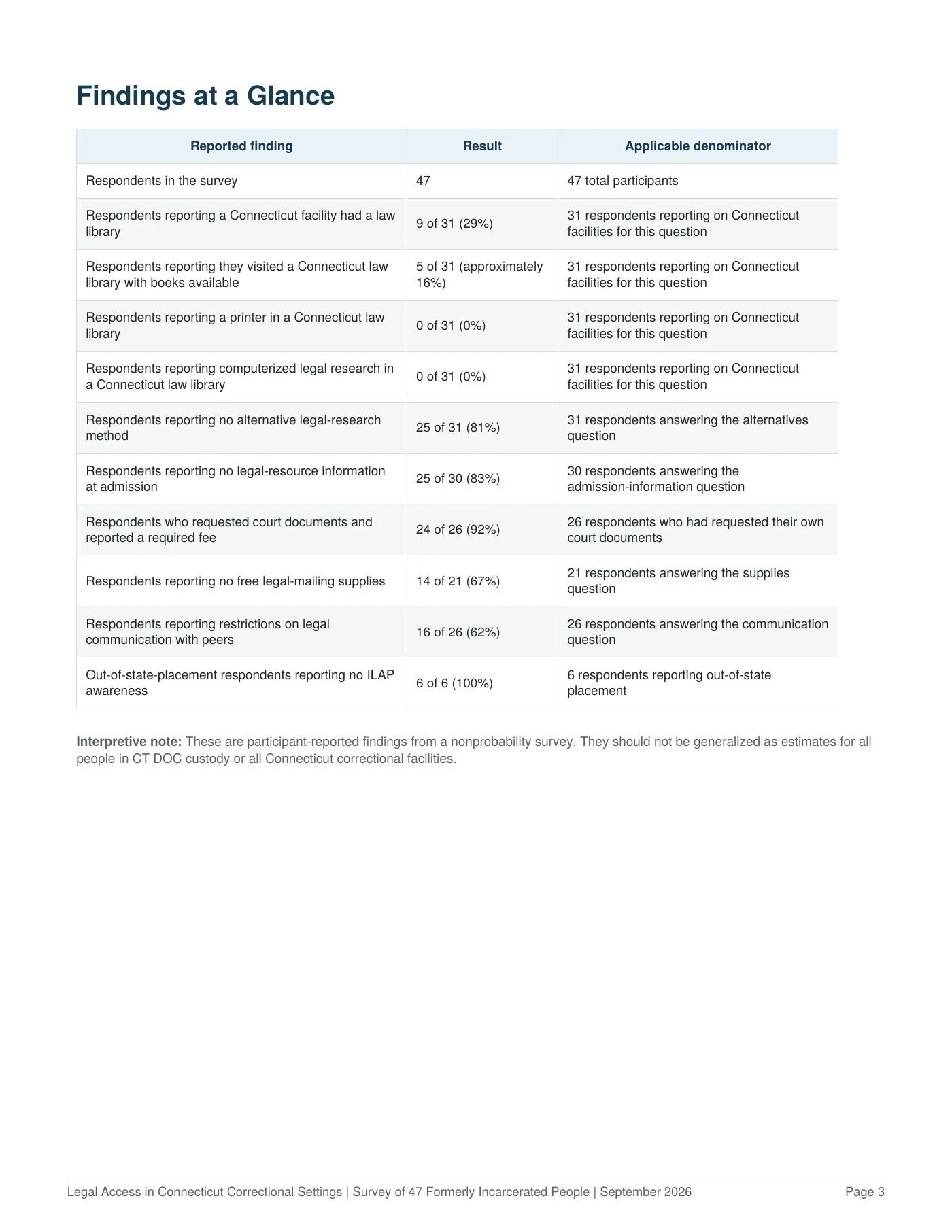
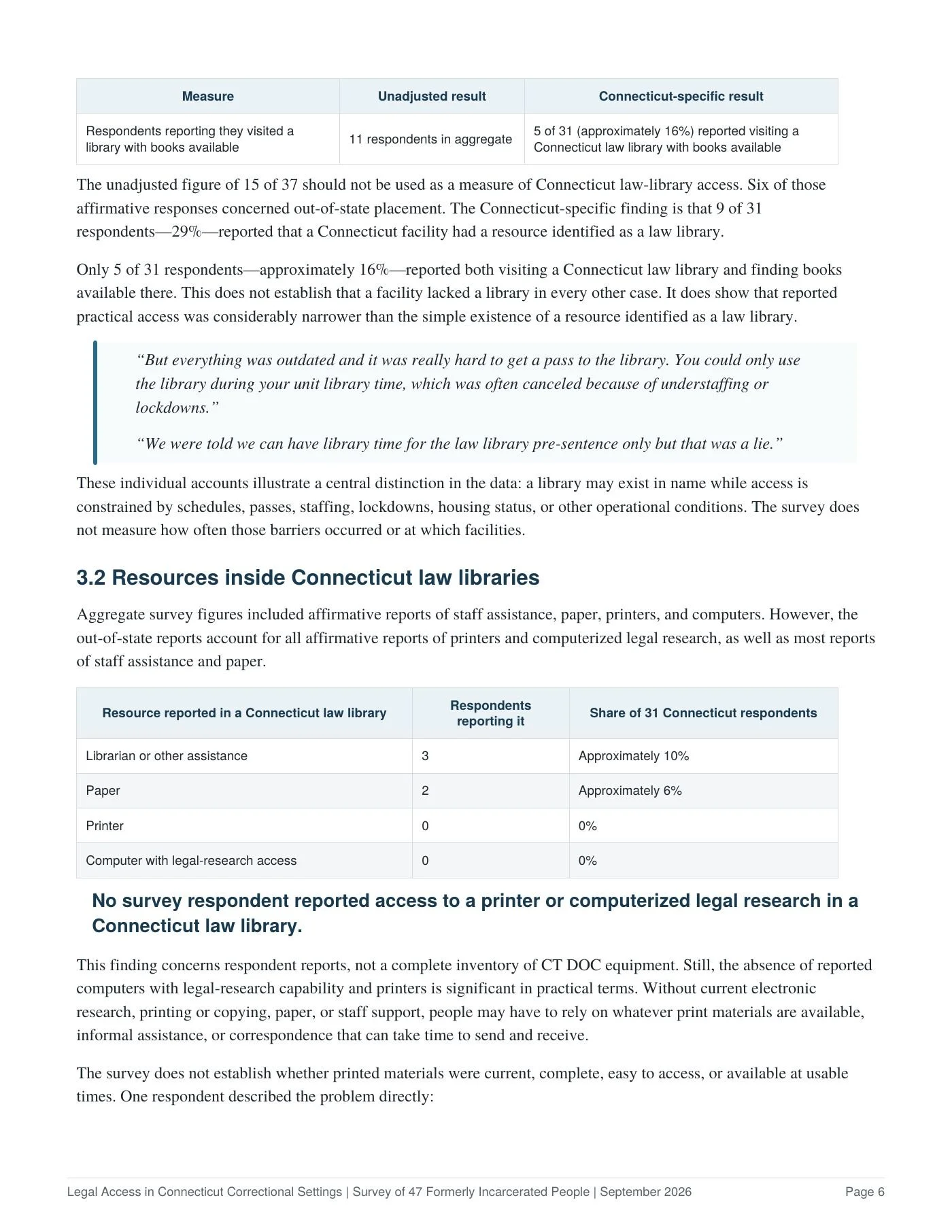
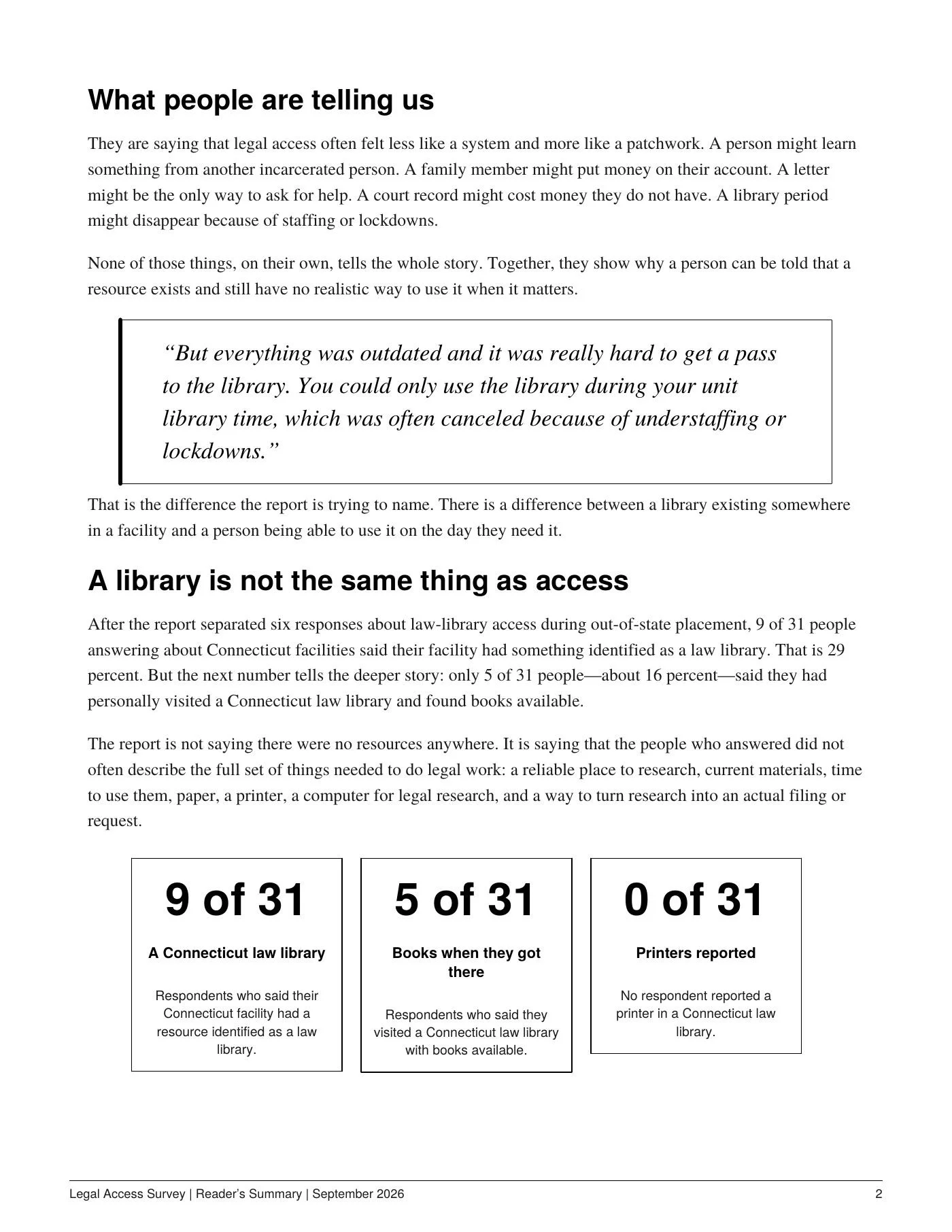
9 of 31 respondents reporting on Connecticut facilities said their facility had a resource identified as a law library. The other 22 said it did not.
Who answered: 31 people answering about Connecticut facilities, after six law-library reports from out-of-state placements were set aside.
Read it carefully: A room called a law library is not the same as being able to use it. The next finding shows how much narrower use was.
Only 5 of 31 reported both personally visiting a Connecticut law library and finding books available there.
Who answered: The same 31 people answering about Connecticut facilities.
Read it carefully: This does not mean every other facility lacked a library. It shows that practical access was much narrower than a library existing.
3 of 31 reported a librarian or other assistance in a Connecticut law library. 2 of 31 reported paper.
Who answered: The same 31 people answering about Connecticut facilities.
Read it carefully: Most aggregate reports of staff help and paper came from out-of-state placements, which the report counts separately.
No respondent reported a printer in a Connecticut law library.
Who answered: The same 31 people answering about Connecticut facilities.
Read it carefully: These are respondent reports, not an inventory of CT DOC equipment.
No respondent reported a computer with legal-research access in a Connecticut law library.
Who answered: The same 31 people answering about Connecticut facilities.
Read it carefully: Every aggregate report of a computer or printer came from an out-of-state placement.
Before out-of-state reports were separated, 15 of 37 said their facility had something identified as a law library. Six of those 15 were about facilities outside Connecticut.
Who answered: 37 people answering the first law-library question, in and out of state.
Read it carefully: Do not quote 15 of 37 as Connecticut access. Combining the two would inflate it. The report uses 9 of 31.
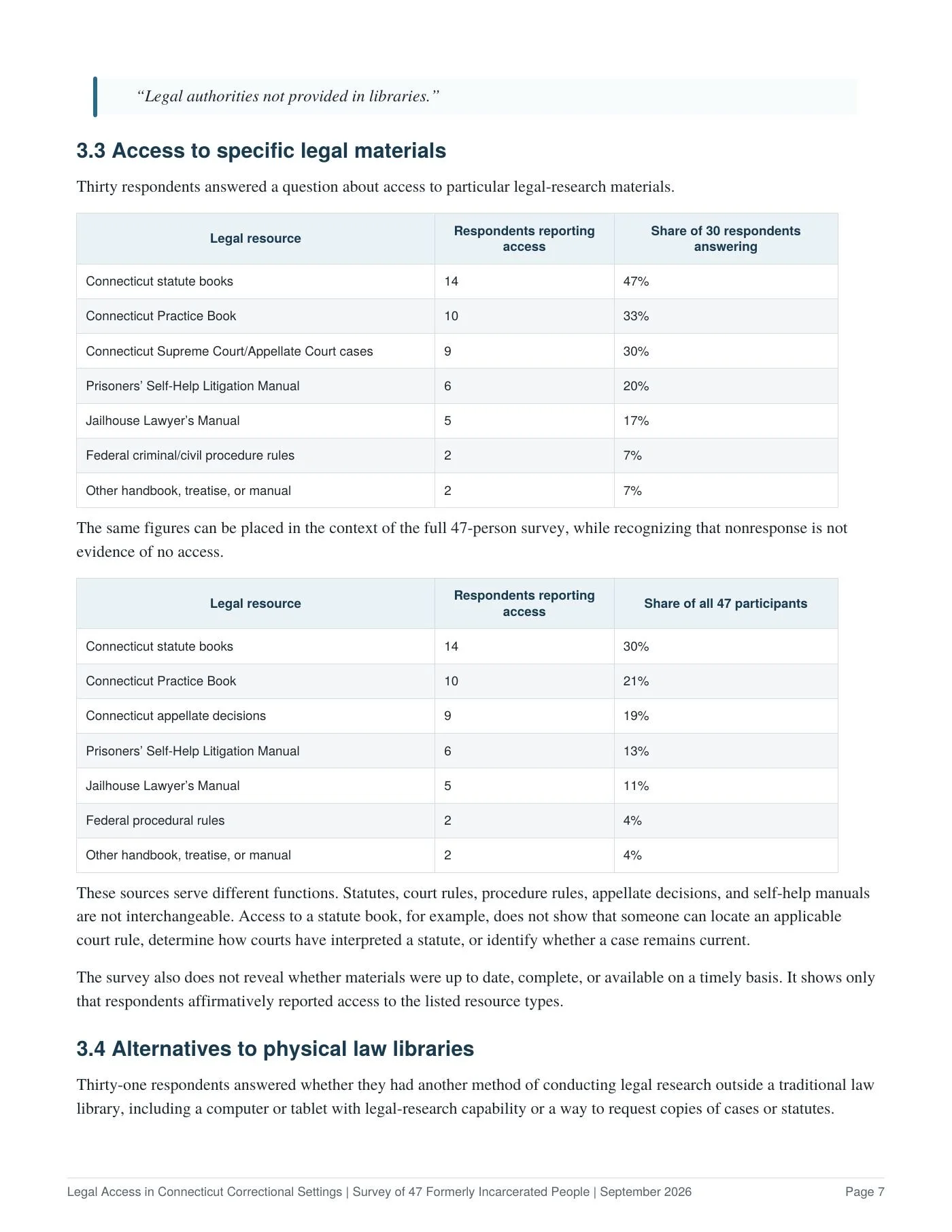
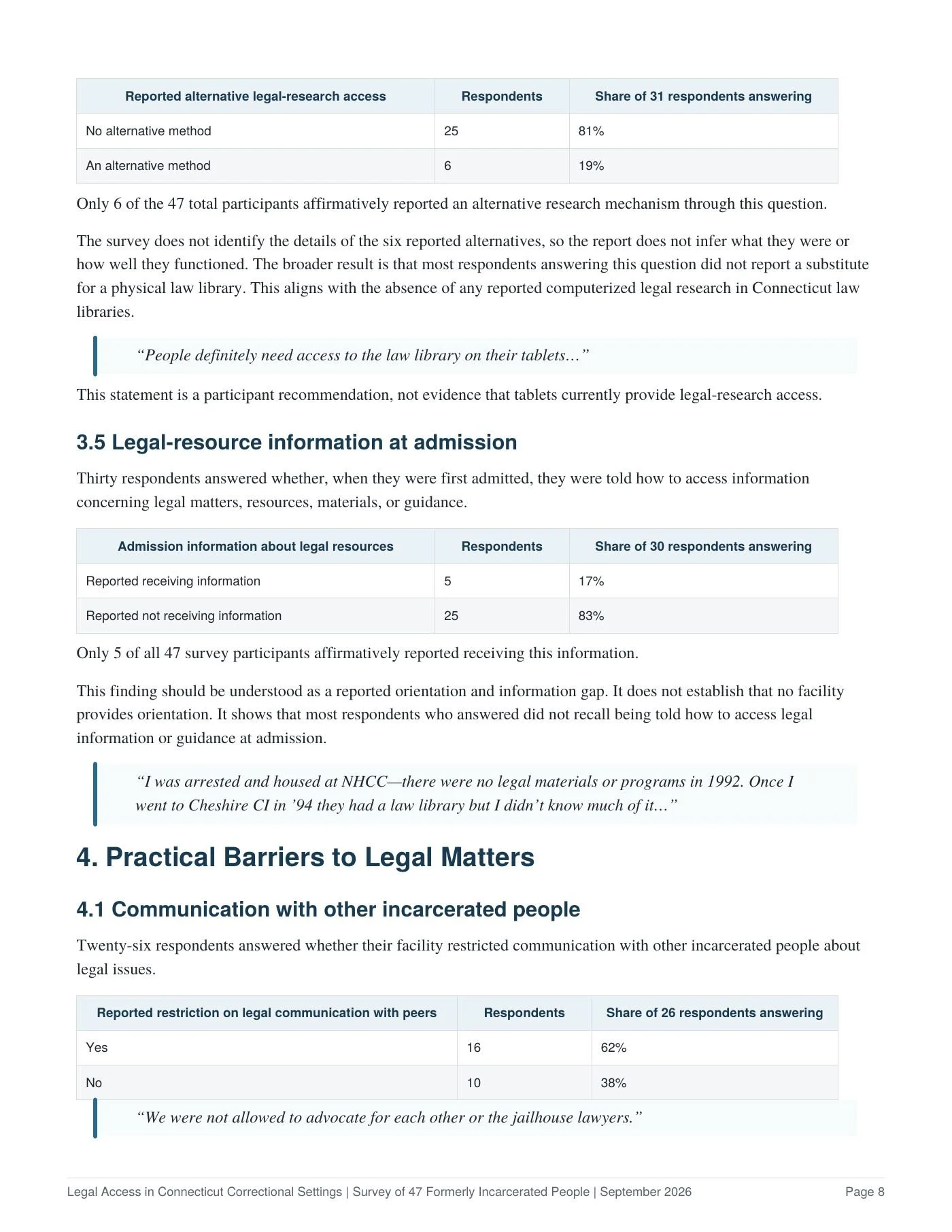
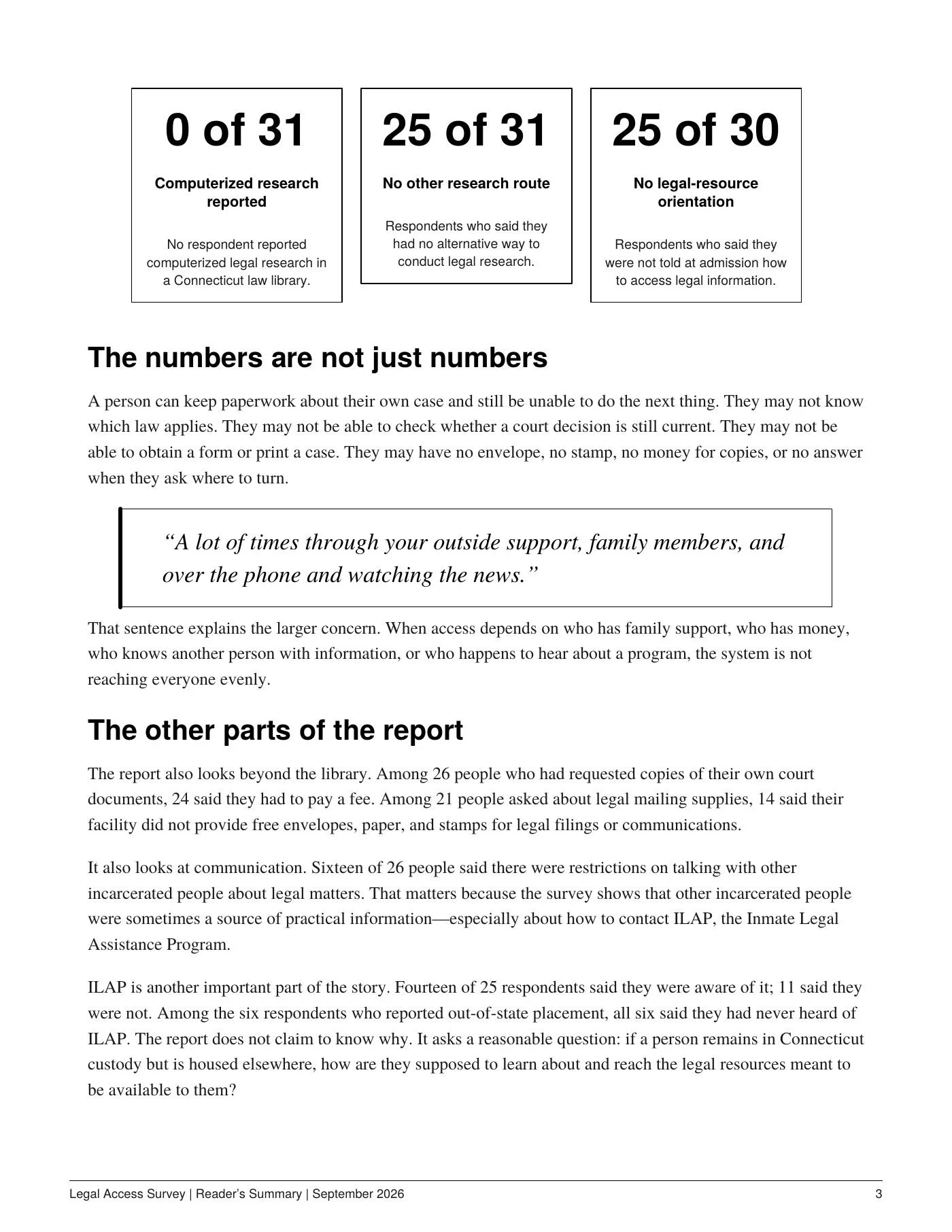
25 of 31 reported no way to do legal research outside a physical law library, such as a tablet, a computer, or a way to request cases and statutes.
Who answered: 31 people answering the question about alternatives.
Read it carefully: The 6 who reported an alternative did not say what it was, so the report does not guess.
25 of 30 said that when they were first admitted, nobody told them how to access legal information, resources, materials or guidance.
Who answered: 30 people answering the admission question.
Read it carefully: Read this as a gap people remember. It does not show that no facility runs an orientation.
Of 26 people who asked a court for copies of their own legal documents, 24 said they had to pay a fee.
Who answered: 26 people who had requested their own court documents.
Read it carefully: The survey does not separate court fees from copying, postage or correctional charges, or show how often fee waivers were granted.
14 of 21 said their facility did not provide free envelopes, paper and stamps for legal filings or communications.
Who answered: 21 people answering the supplies question.
Read it carefully: Seven of 21 said their facility did provide them.
14 of 20 said the facility opened incoming mail marked as legal communication. Separately, 11 of 19 said mail from ILAP was opened.
Who answered: 20 people answering the legal-mail question (19 for ILAP mail).
Read it carefully: The survey does not show whether mail was opened in the person’s presence, read, copied or delayed. Those details decide whether a practice complies with policy or law.
16 of 26 reported restrictions on communicating with other incarcerated people about legal matters.
Who answered: 26 people answering the communication question.
Read it carefully: The survey does not show the legal basis, scope or enforcement of these rules. Peers were also a main source of ILAP contact information.
14 of 25 said they were aware of ILAP. 11 were not, and all 11 of them also said they knew of no other lawyer or firm taking calls for free legal advice.
Who answered: 25 people answering the ILAP awareness question.
Read it carefully: This measures awareness. It does not show that no legal help existed.
12 of 23 said they did not receive information about how to contact ILAP. Of 8 people who said where they did get it, 5 named another incarcerated person.
Who answered: 23 people answering the contact-information question.
Read it carefully: The survey does not test whether limits on peer communication lowered ILAP awareness.
All 6 respondents who reported an out-of-state placement said they had never heard of ILAP.
Who answered: 6 people who reported being placed outside Connecticut while in CT DOC custody.
Read it carefully: The survey does not show why. It raises a question about services for people in Connecticut custody housed elsewhere.
None of the 11 respondents who answered this question reported that ILAP represented them in a legal proceeding.
Who answered: 11 people answering the representation question.
Read it carefully: This does not show ILAP never represents anyone. It describes these 11 answers only.
From a formal resource to one that works
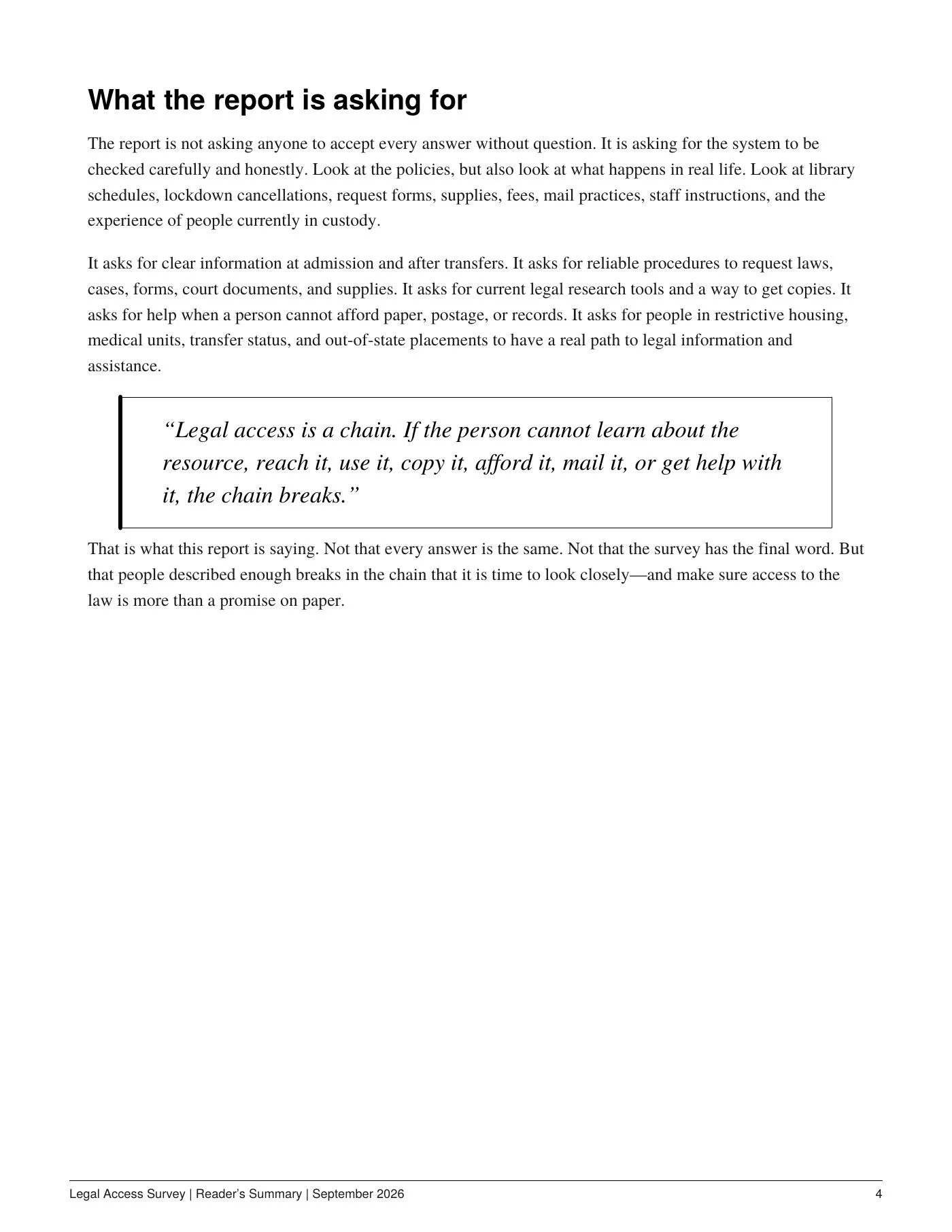
"Legal access is a chain. If the person cannot learn about the resource, reach it, use it, copy it, afford it, mail it, or get help with it, the chain breaks."
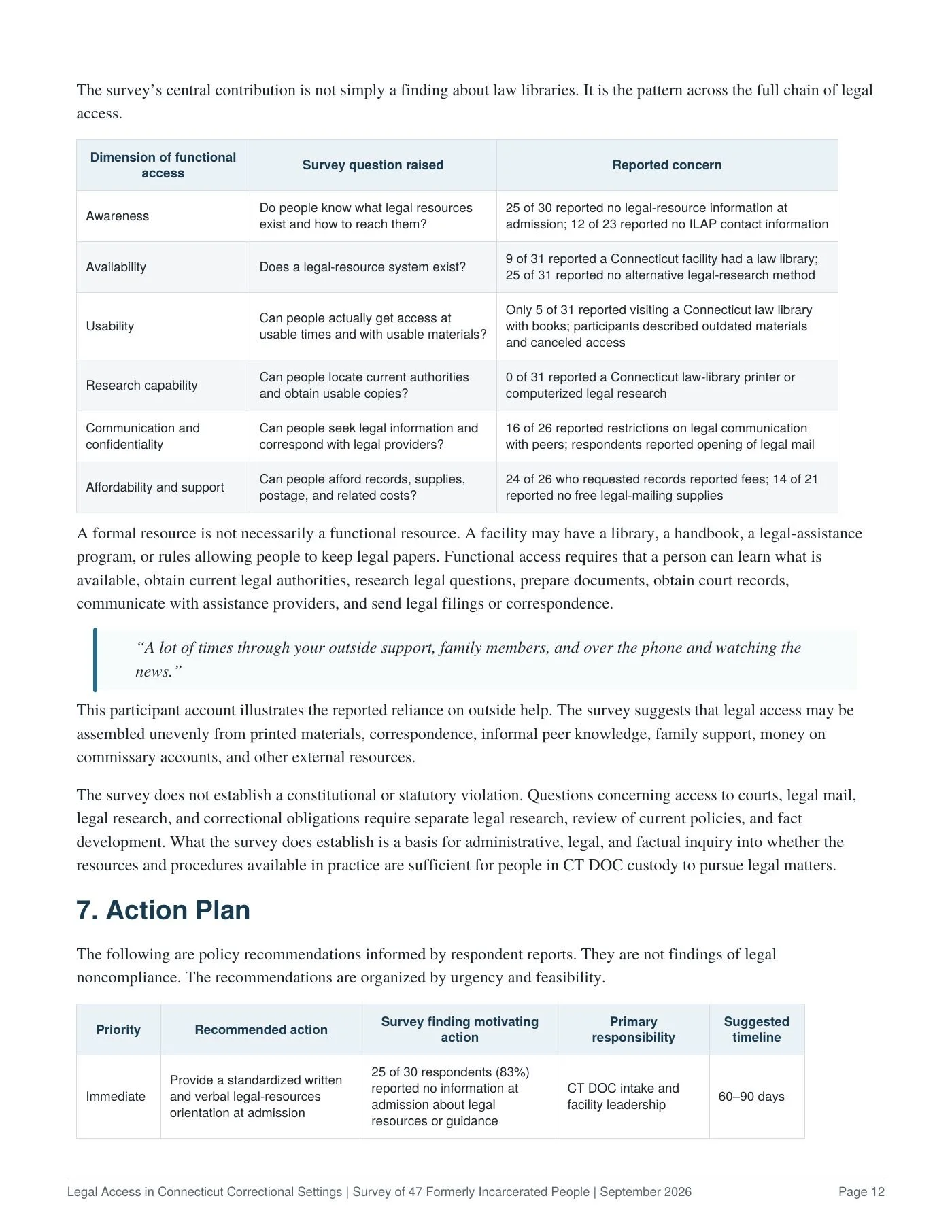
| Dimension | The question | What respondents reported |
|---|---|---|
| Awareness | Do people know what legal resources exist and how to reach them? | 25 of 30 got no legal-resource information at admission. 12 of 23 got no ILAP contact information. |
| Availability | Does a legal-resource system exist? | 9 of 31 reported a law library in their Connecticut facility. 25 of 31 had no other way to research. |
| Usability | Can people get in at usable times, with usable materials? | 5 of 31 visited a Connecticut law library with books. Participants described outdated materials and canceled library time. |
| Research capability | Can people find current law and get usable copies? | 0 of 31 reported a printer or computerized legal research in a Connecticut law library. |
| Communication and confidentiality | Can people seek legal information and write to legal providers? | 16 of 26 reported limits on talking about legal matters with peers. Respondents reported legal mail being opened. |
| Affordability and support | Can people afford records, supplies and postage? | 24 of 26 who requested court records were charged a fee. 14 of 21 got no free legal-mailing supplies. |
"But everything was outdated and it was really hard to get a pass to the library. You could only use the library during your unit library time, which was often canceled because of understaffing or lockdowns."
Open a chapter for what it shows, what it cannot show, and where to find it
Start here if you have five minutes. The summary sets out the method and its limits, then the main results: the law-library findings, the lack of research alternatives, admission information, court-document fees, legal supplies, communication with peers, and ILAP.
The table on page 3 lists each headline result next to the exact group of people it describes. When you quote a number, quote that group with it.
47 people completed the survey through an open link that could be shared and forwarded, an approach often called snowball sampling. Each could describe up to three facilities. Skip logic means denominators range from 19 to 37.
Related concerns that recur across many parts of legal access, strong enough to justify records review, direct observation, confidential interviews and a larger study.
When each experience happened, whether it reflected written policy or local practice, whether it has changed, or which housing unit or custody level it came from. Words like "law library" may have meant different things to different people.
The chapter also explains the law-library adjustment: 15 of 37 before separating out-of-state reports, 9 of 31 after. The Connecticut-only figure is the one to use.
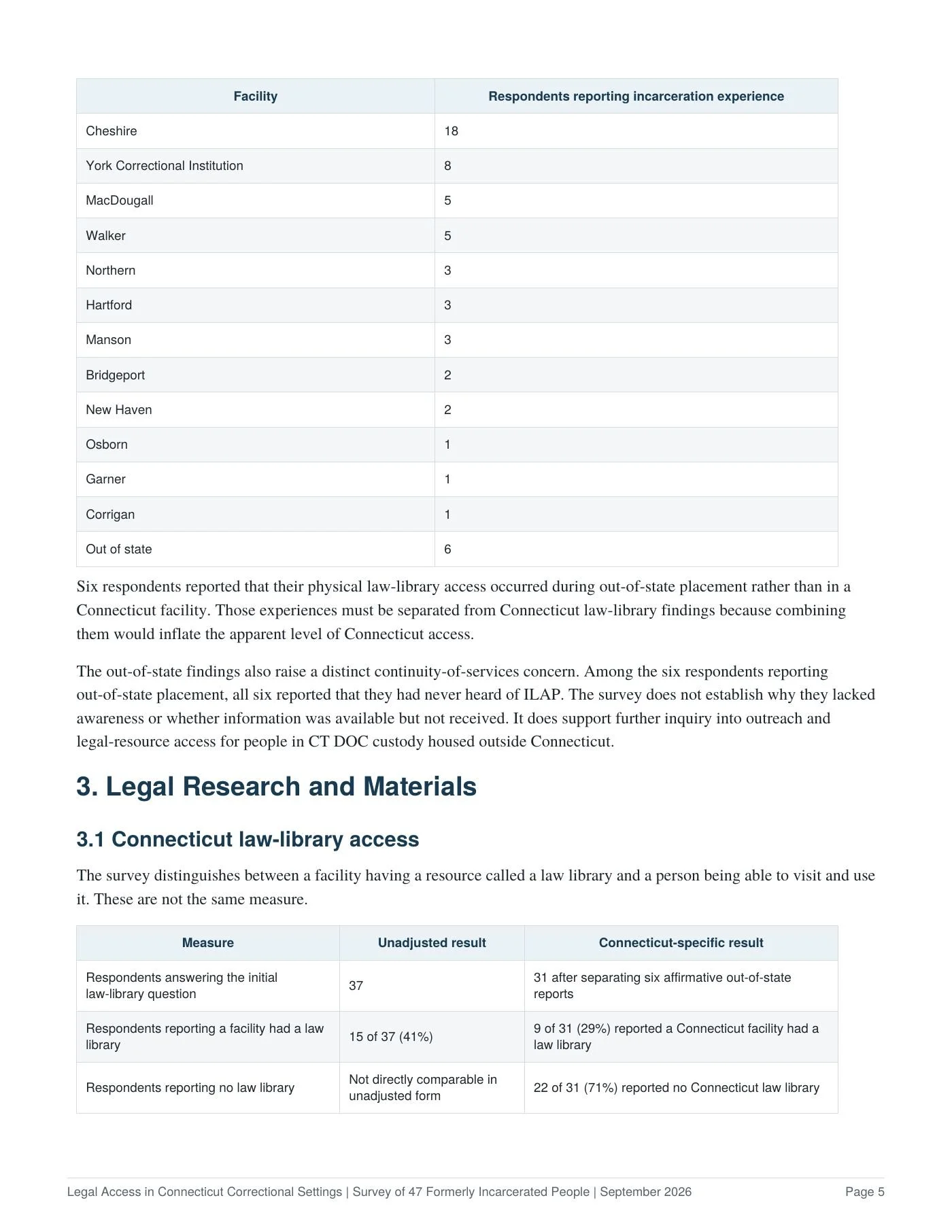
| Facility | Respondents | Facility | Respondents |
|---|---|---|---|
| Cheshire | 18 | Bridgeport | 2 |
| York Correctional Institution | 8 | New Haven | 2 |
| MacDougall | 5 | Osborn | 1 |
| Walker | 5 | Garner | 1 |
| Northern | 3 | Corrigan | 1 |
| Hartford | 3 | Out of state | 6 |
| Manson | 3 |
Respondents had been held across at least twelve Connecticut facilities, and six had been placed out of state. All six of those said they had never heard of ILAP.
These counts are not facility populations, admissions or performance measures. They do not support rankings or comparisons between facilities.
9 of 31 reported a Connecticut facility had a law library; 22 of 31 reported none. Only 5 of 31 reported visiting one and finding books. A library may exist in name while schedules, passes, staffing, lockdowns or housing status keep people out.
Of the 31: librarian or other help, 3 (about 10%); paper, 2 (about 6%); printer, 0; computer with legal research, 0. Out-of-state reports account for every aggregate report of printers and computers.
| Legal resource | Reported access | Share of 30 answering |
|---|---|---|
| Connecticut statute books | 14 | 47% |
| Connecticut Practice Book | 10 | 33% |
| Connecticut Supreme Court and Appellate Court cases | 9 | 30% |
| Prisoners' Self-Help Litigation Manual | 6 | 20% |
| Jailhouse Lawyer's Manual | 5 | 17% |
| Federal criminal and civil procedure rules | 2 | 7% |
| Other handbook, treatise or manual | 2 | 7% |
These sources do different jobs. A statute book alone does not tell you which court rule applies, how courts have read the statute, or whether a case is still good law. The survey also does not show whether materials were current or complete.
25 of 31 (81%) reported no alternative, such as a tablet, a computer, or a way to request cases and statutes. 6 of 31 reported one, without saying what it was.
25 of 30 (83%) said they were not told at admission how to get legal information or guidance; 5 of 30 said they were.
16 of 26 (62%) reported restrictions on discussing legal matters with other incarcerated people; 10 of 26 did not. The report asks reviewers to separate rules against unauthorized legal representation from rules that block sharing legal information.
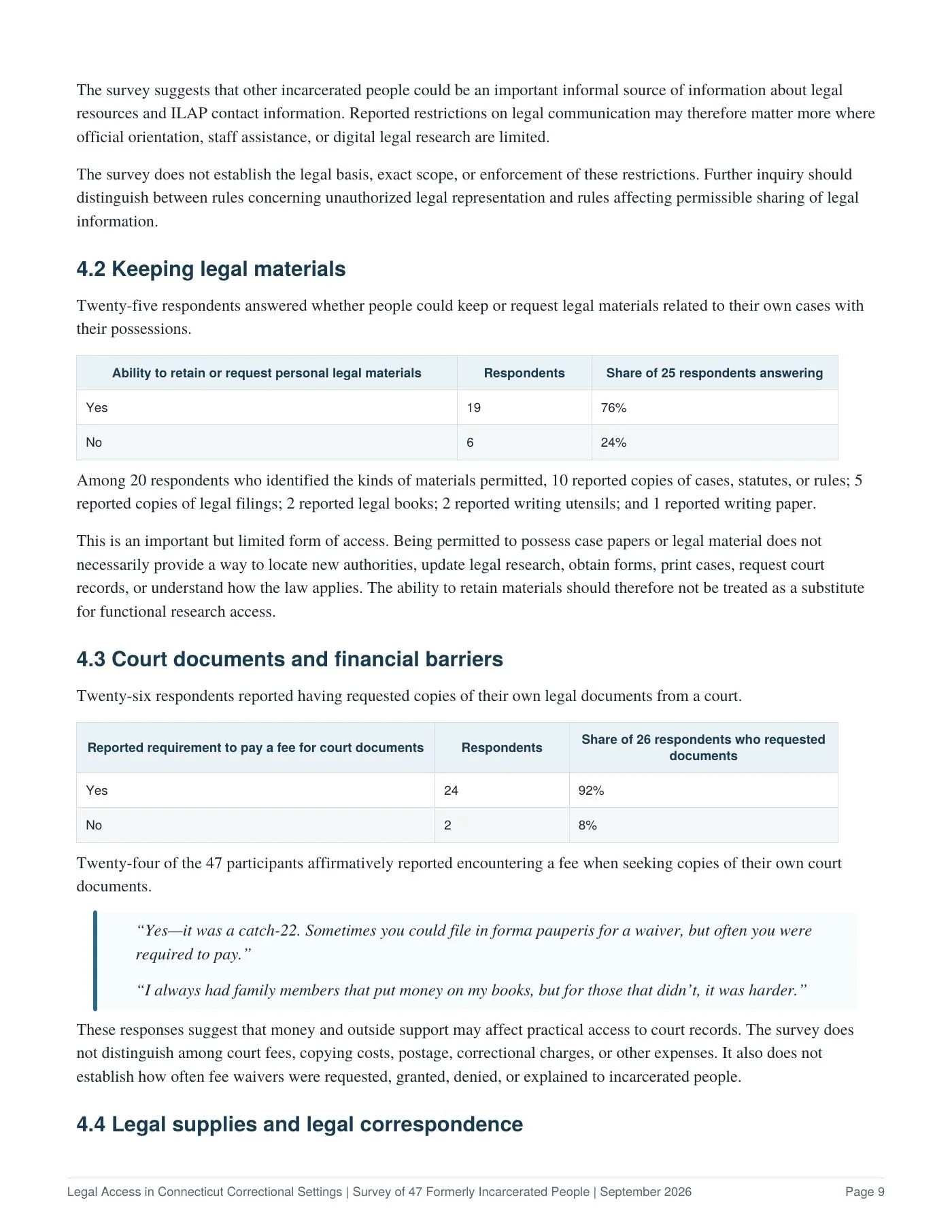
19 of 25 (76%) could keep or request papers about their own case. Of 20 who said what was allowed: copies of cases, statutes or rules, 10; legal filings, 5; legal books, 2; writing utensils, 2; writing paper, 1. Keeping papers is not the same as being able to find new law, print it or file it.
24 of 26 (92%) who requested their own court documents were required to pay a fee; 2 were not. Participants described relying on family money, and fee waivers that were available only sometimes.
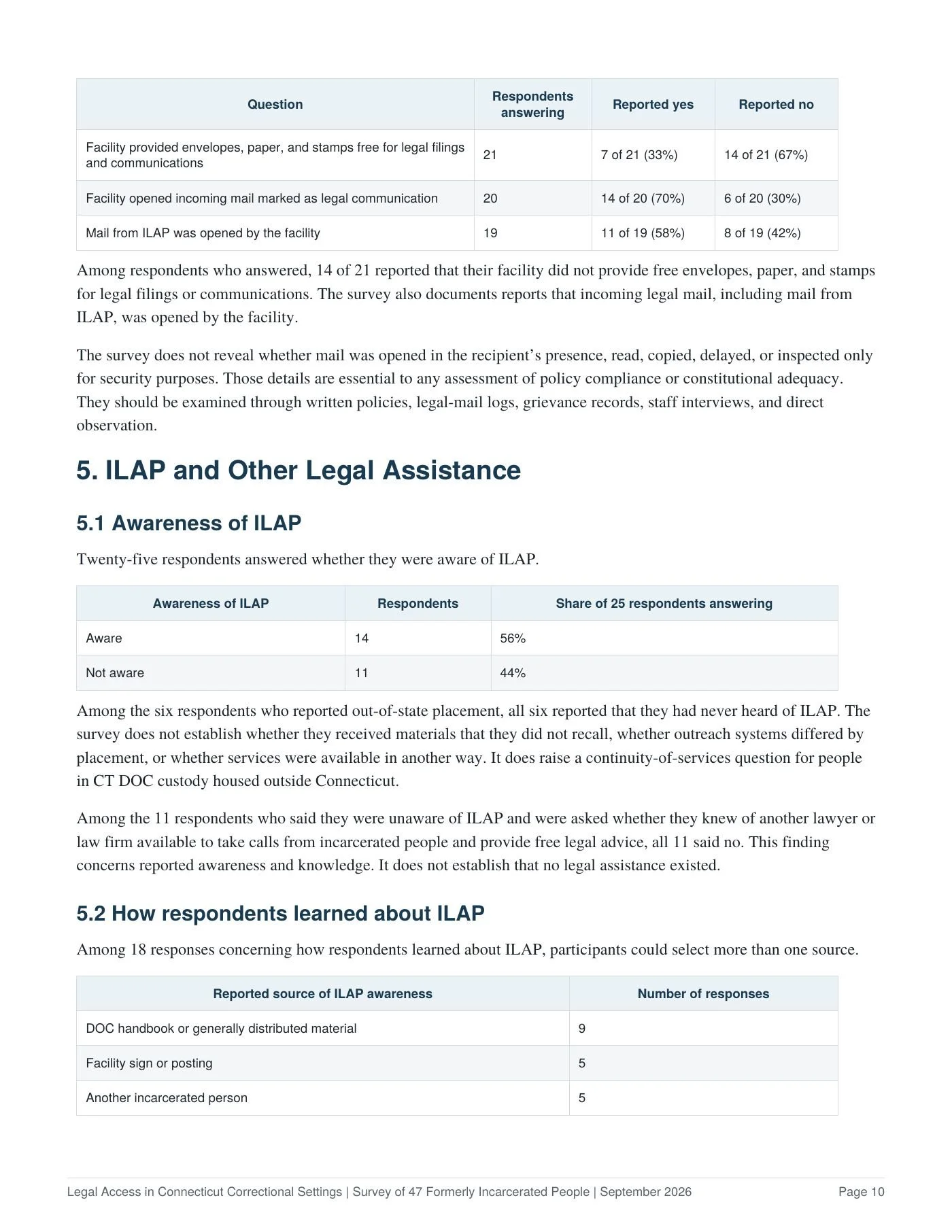
| Question | Answering | Yes | No |
|---|---|---|---|
| Facility gave free envelopes, paper and stamps for legal filings | 21 | 7 (33%) | 14 (67%) |
| Facility opened incoming mail marked as legal | 20 | 14 (70%) | 6 (30%) |
| Mail from ILAP was opened by the facility | 19 | 11 (58%) | 8 (42%) |
The survey does not show whether mail was opened in the person's presence, read, copied or delayed. The report says those details must come from written policies, mail logs, grievances, staff interviews and observation.
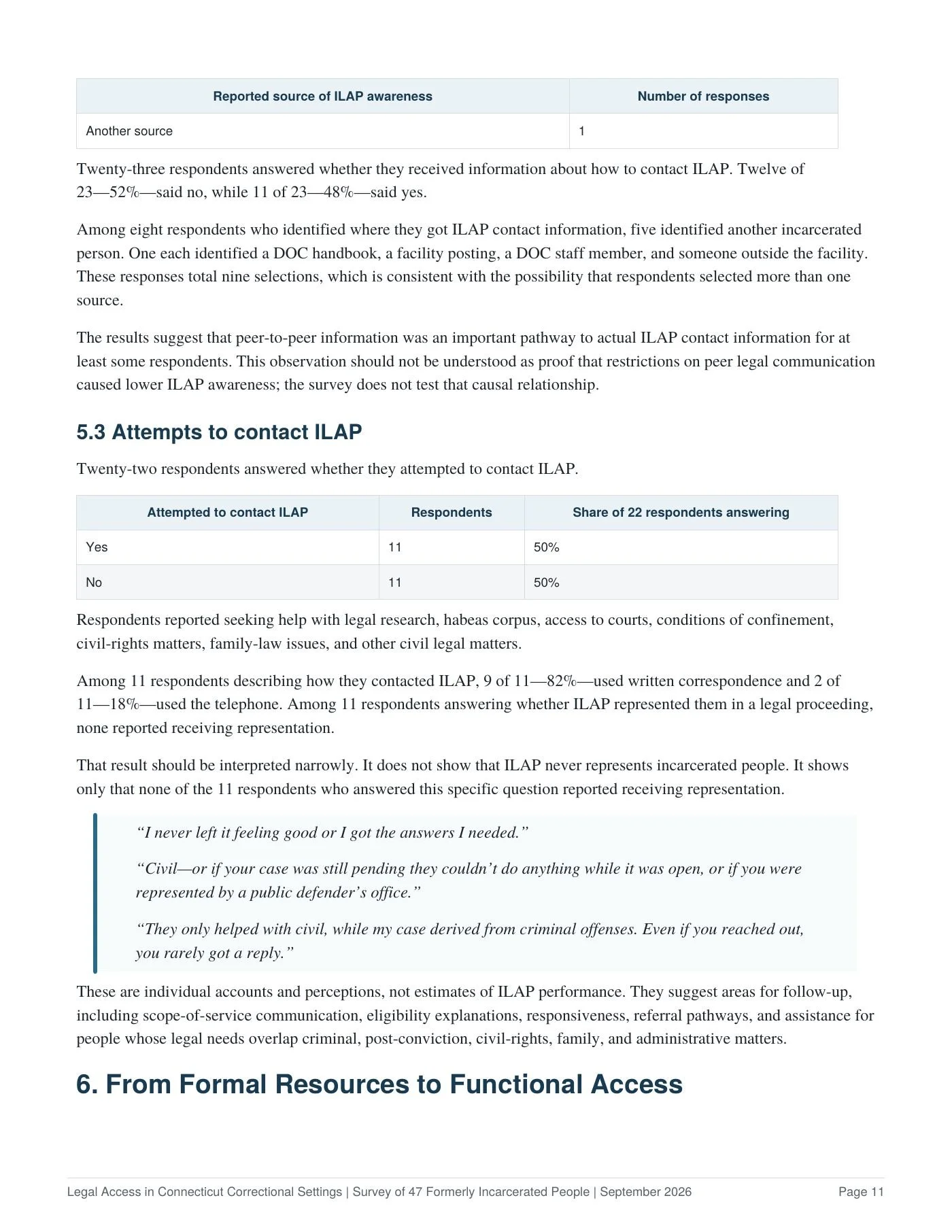
14 of 25 (56%) knew about ILAP; 11 (44%) did not, and all 11 knew of no other free legal advice line. All 6 people placed out of state had never heard of it.
From 18 responses, where people could pick more than one source: a DOC handbook or general material, 9; a facility sign or posting, 5; another incarcerated person, 5; another source, 1. 12 of 23 got no ILAP contact information. Of 8 who said where they got it, 5 named another incarcerated person.
11 of 22 tried to contact ILAP, for help with legal research, habeas corpus, access to courts, conditions of confinement, civil rights, family law and other civil matters. 9 of 11 wrote and 2 of 11 called. None of the 11 who answered reported being represented in a proceeding. That does not show ILAP never represents anyone; it raises questions about outreach, scope, eligibility, response times and referrals.
This chapter lines the findings up across six dimensions: awareness, availability, usability, research capability, communication and confidentiality, and affordability and support. The chain section above shows that table.
The report is careful here: it does not find a constitutional or statutory violation. It says the findings justify administrative, legal and factual inquiry into whether what is available in practice lets people in CT DOC custody pursue legal matters.
The recommendations are policy proposals informed by what respondents reported, not findings of legal noncompliance. They are laid out in full under What comes next, below.
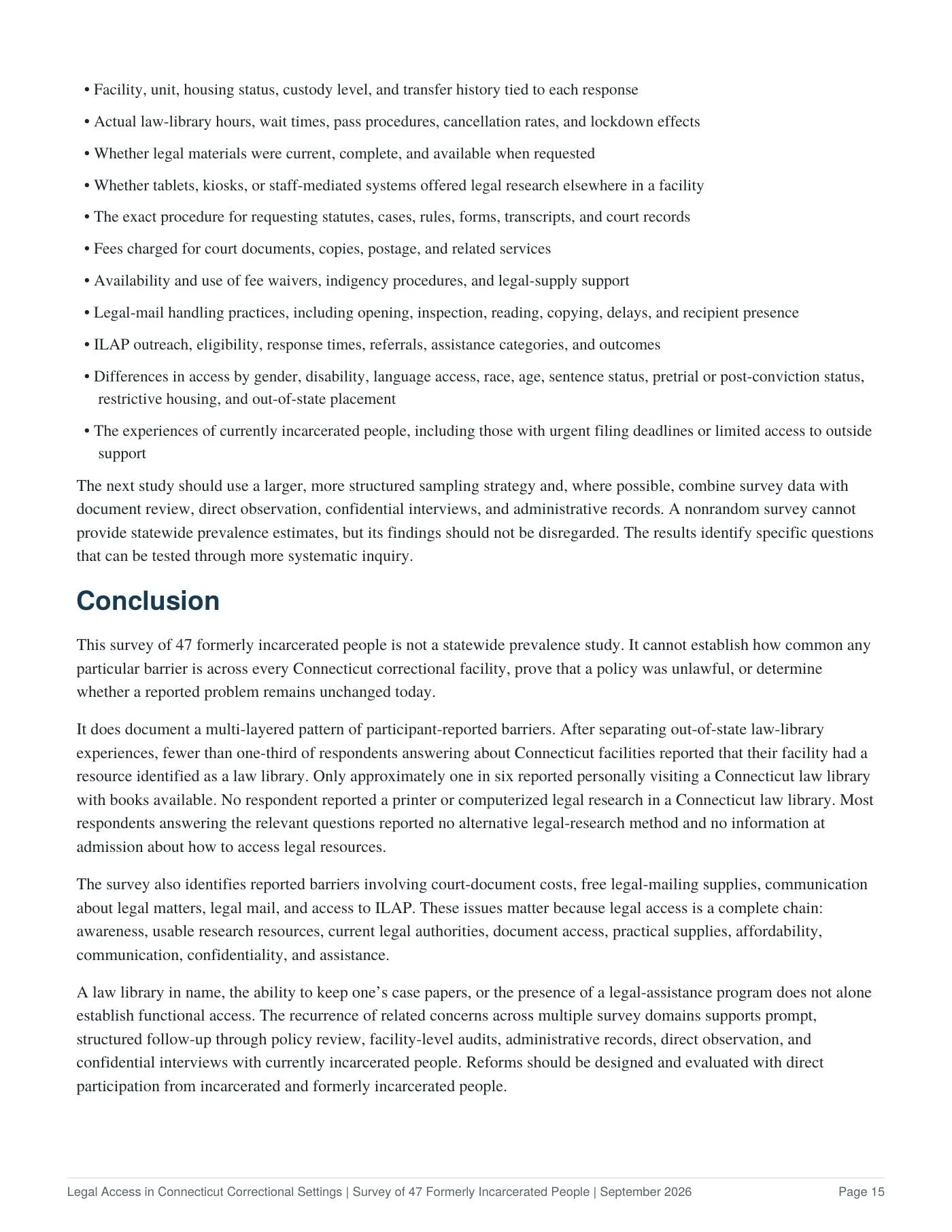
The report recommends a larger, more structured study that combines surveys with document review, direct observation, confidential interviews and administrative records.
The survey is not a statewide prevalence study and cannot prove a policy was unlawful or that a problem continues today. It does document a pattern across many parts of legal access at once. Fewer than one in three Connecticut respondents reported a law library, about one in six reported visiting one with books, and none reported a printer or computerized research there.
A law library in name, permission to keep case papers, or the existence of a legal-assistance program does not by itself establish functional access. The report calls for prompt, structured follow-up, and for incarcerated and formerly incarcerated people to help design and evaluate reforms.
The report and its two companion guides
The full findings, with every table, denominator and caveat, the action plan and the data gaps. Use it when you need to cite a number or check a claim.
A plain-language essay on what people are saying and why the numbers matter. Start here if you are new to the report, or share it with family and community members.
For meetings, testimony, press, family conversations and community spaces: what to say, what not to say, short and long versions, and answers to common pushback.
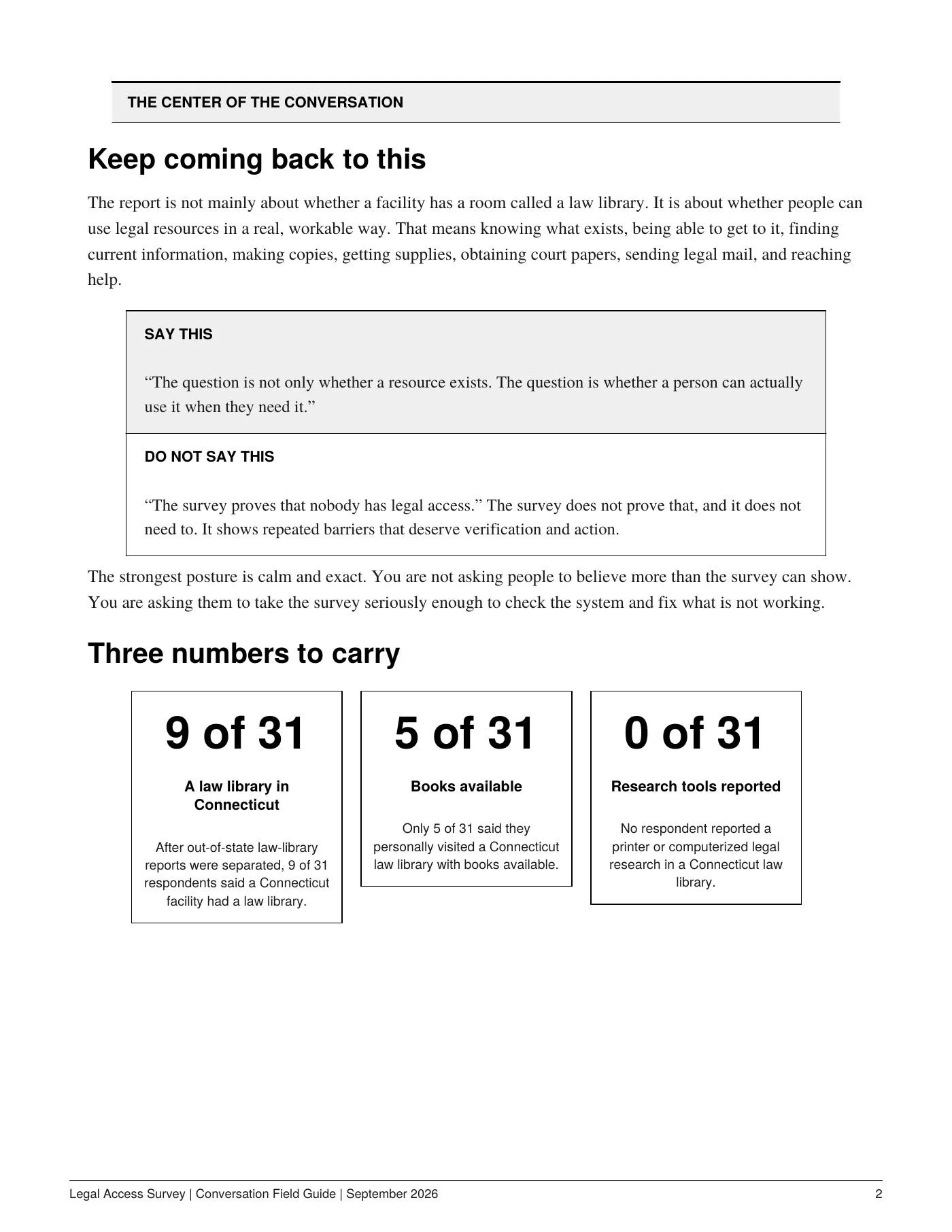
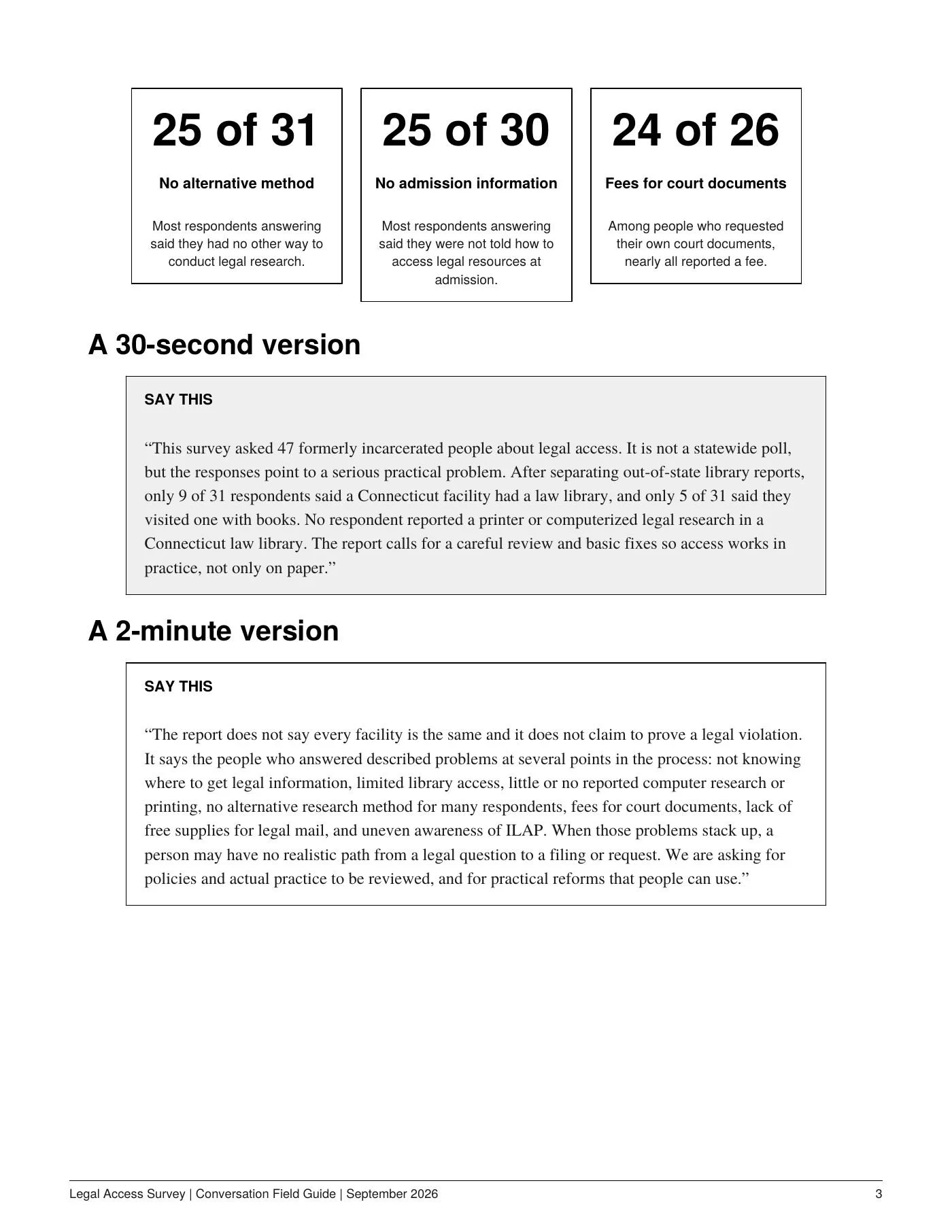
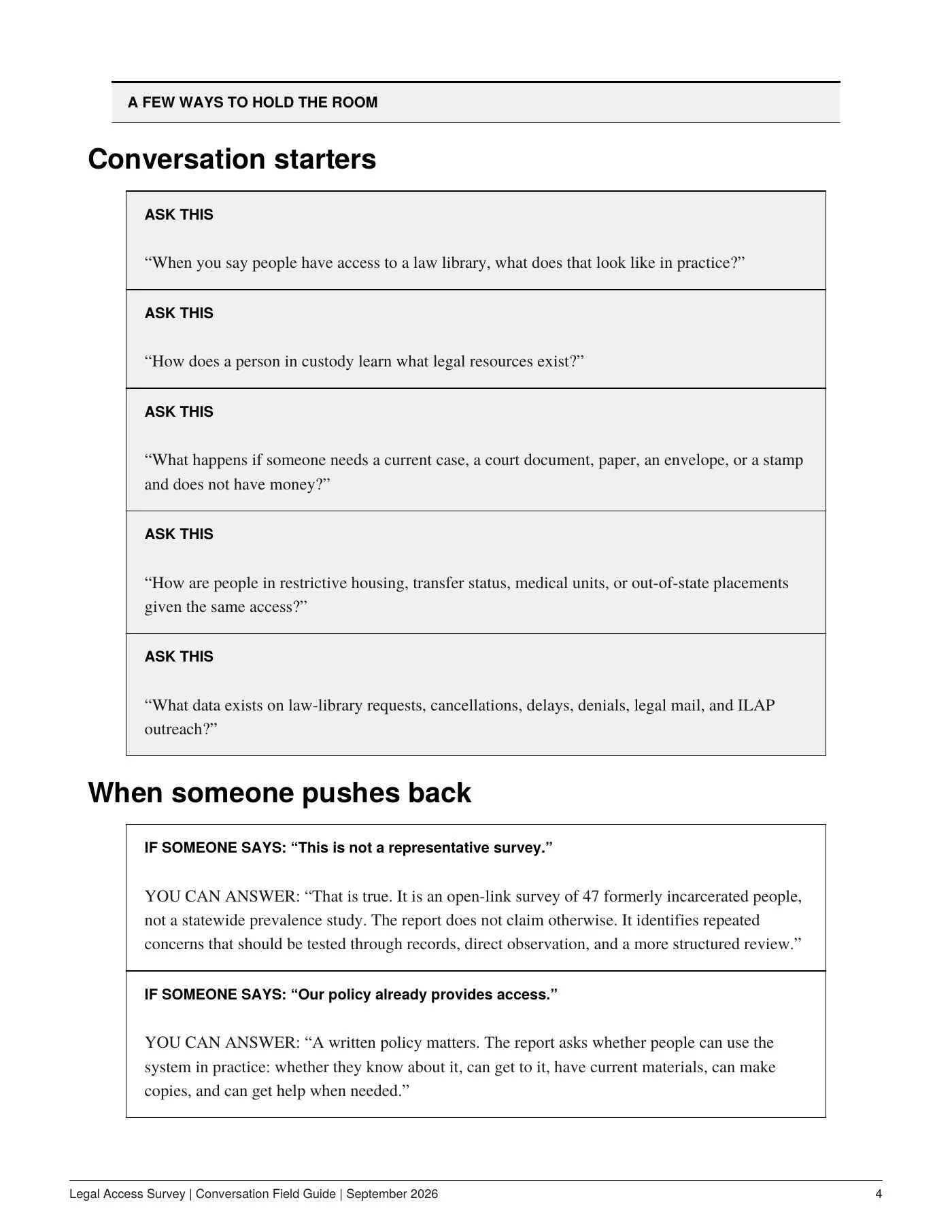
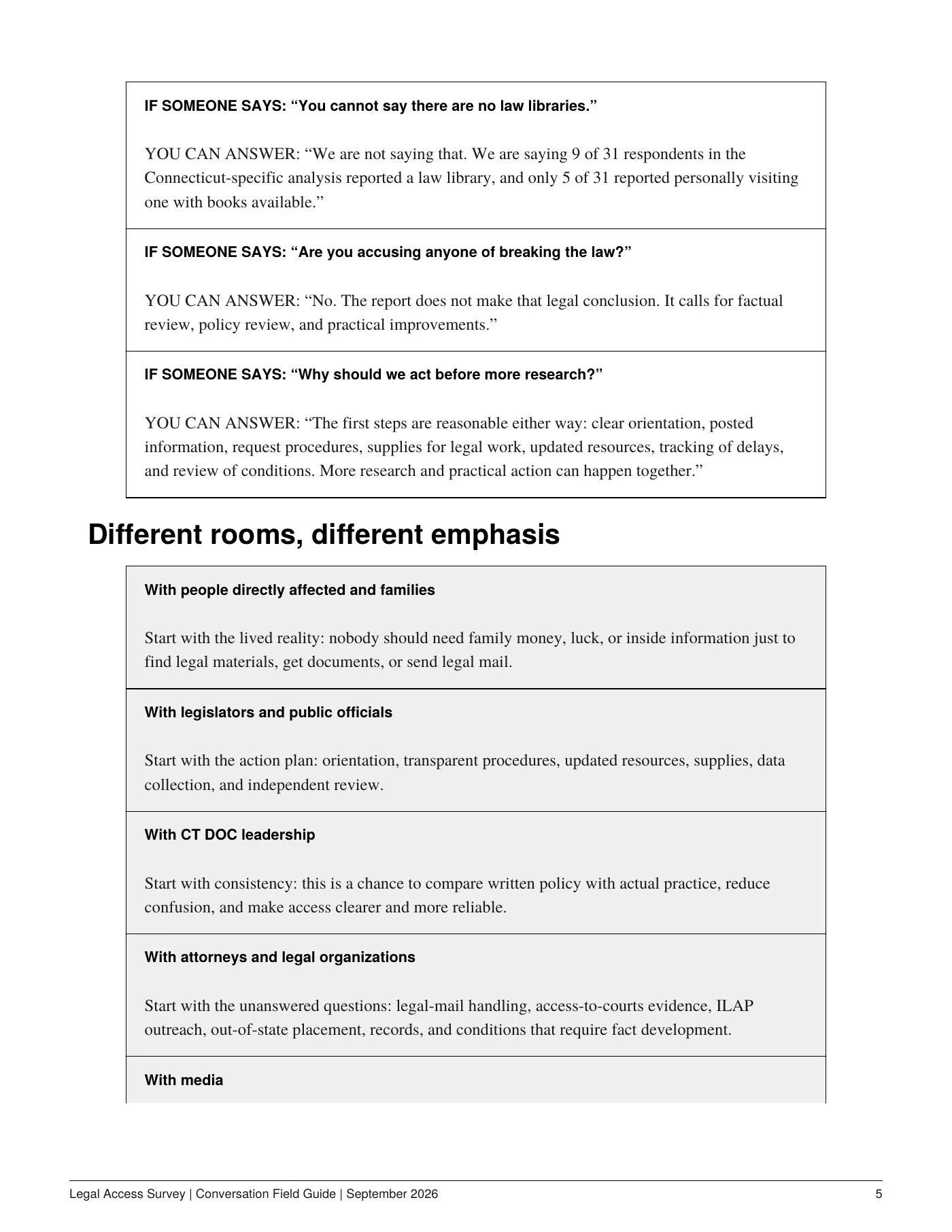
From the conversation field guide
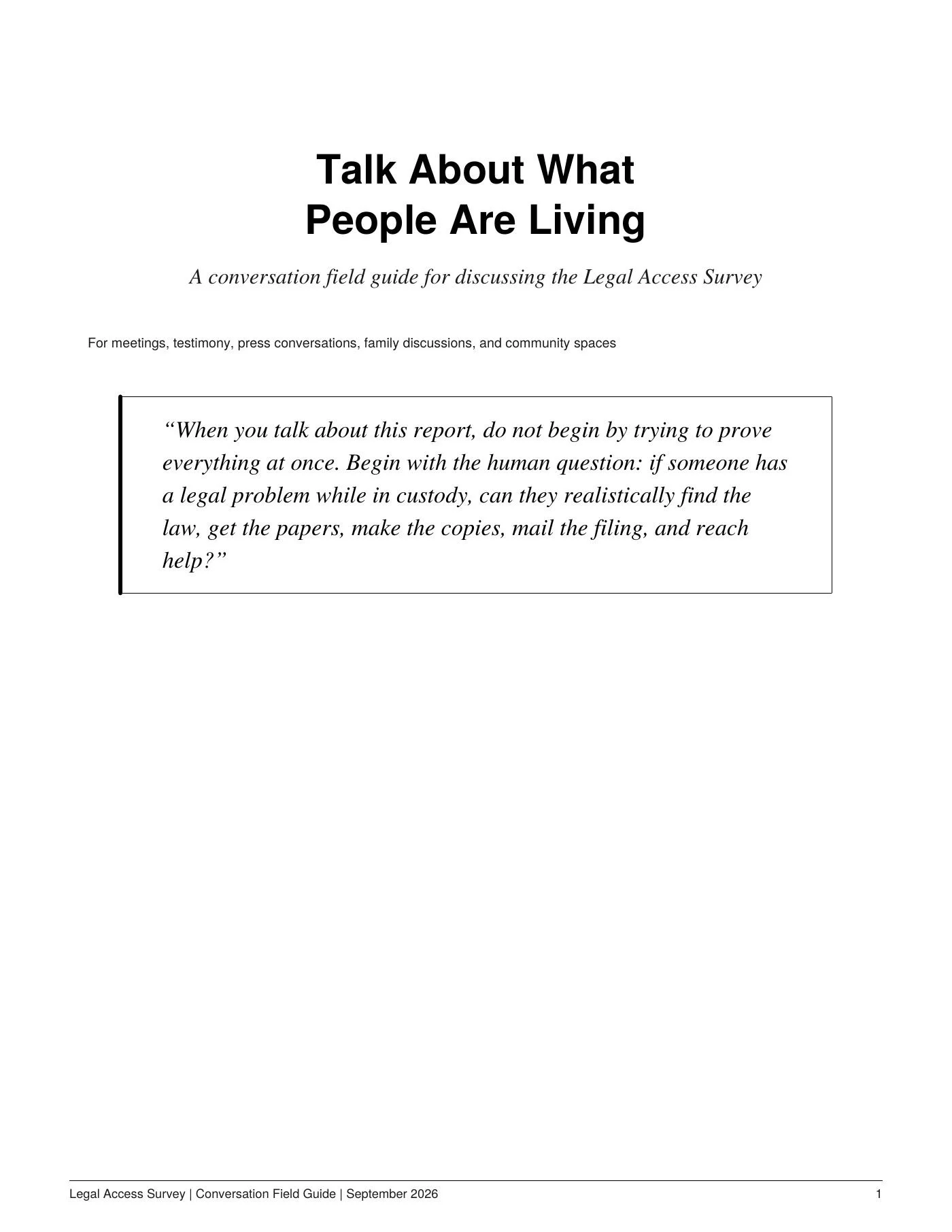
"Begin with the human question: if someone has a legal problem while in custody, can they realistically find the law, get the papers, make the copies, mail the filing, and reach help?"
"The question is not only whether a resource exists. The question is whether a person can actually use it when they need it."
"The survey proves that nobody has legal access."
It does not prove that, and it does not need to. It shows repeated barriers that deserve verification and action.
This survey asked 47 formerly incarcerated people about legal access. It is not a statewide poll, but the responses point to a serious practical problem. After separating out-of-state library reports, only 9 of 31 respondents said a Connecticut facility had a law library, and only 5 of 31 said they visited one with books. No respondent reported a printer or computerized legal research in a Connecticut law library. The report calls for a careful review and basic fixes so access works in practice, not only on paper.
That is true. It is an open-link survey of 47 formerly incarcerated people, not a statewide prevalence study, and the report does not claim otherwise. It identifies repeated concerns that should be tested through records, direct observation and a more structured review.
A written policy matters. The report asks whether people can use the system in practice: whether they know about it, can get to it, have current materials, can make copies and can get help when they need it.
We are not saying that. 9 of 31 respondents in the Connecticut analysis reported a law library, and only 5 of 31 reported personally visiting one with books available.
No. The report does not make that legal conclusion. It calls for factual review, policy review and practical improvements.
The first steps are reasonable either way: clear orientation, posted information, request procedures, supplies for legal work, updated resources, tracking of delays and review of conditions. More research and practical action can happen together.
The report's action plan, in full
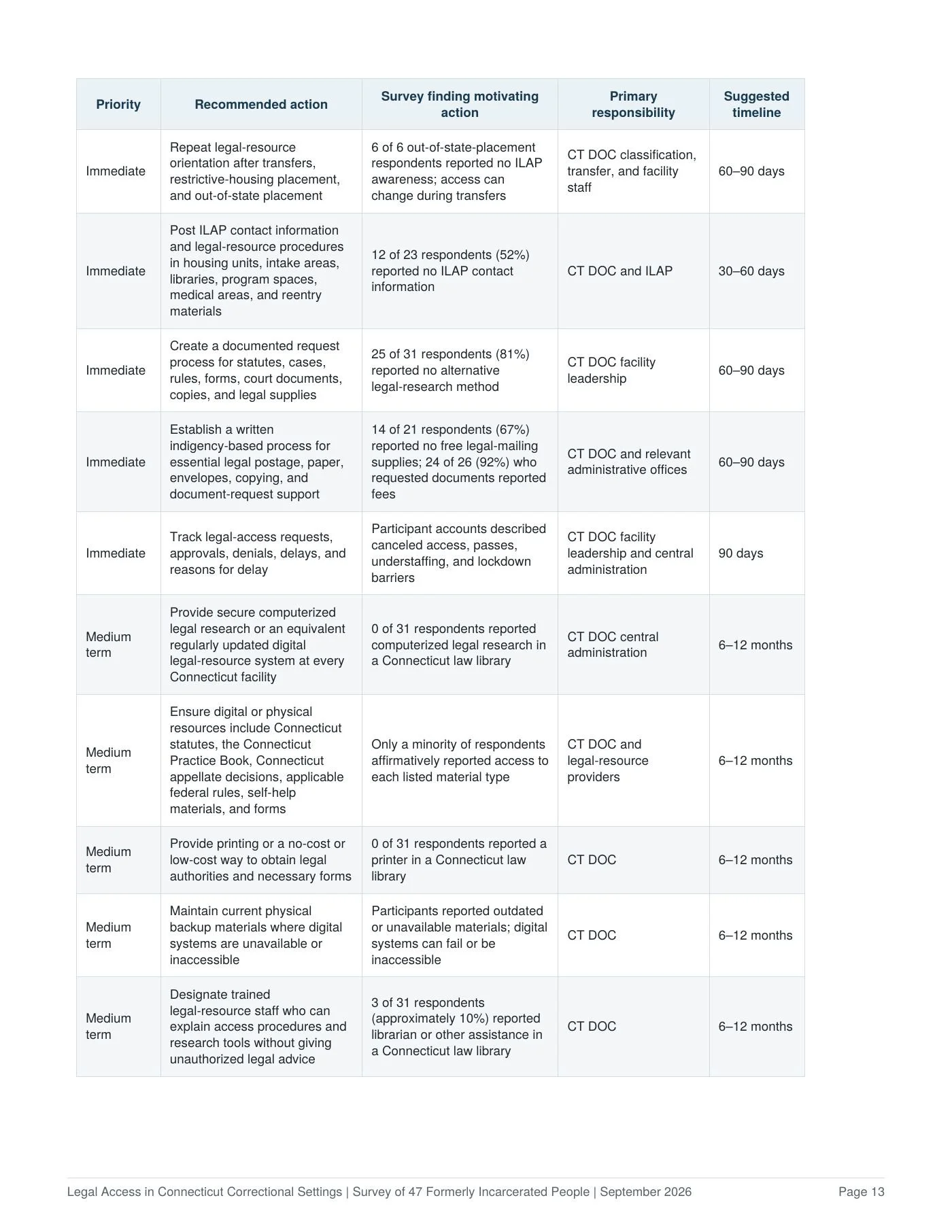
These are policy recommendations informed by what respondents reported. They are not findings that anyone broke the law. Each one names the finding behind it, who is primarily responsible, and a suggested timeline.
Immediate steps, within 30 to 90 days.
| Action | Why | Who | When |
|---|---|---|---|
| A standard written and spoken legal-resources orientation at admission | 25 of 30 (83%) got no legal-resource information at admission | CT DOC intake and facility leadership | 60–90 days |
| Repeat the orientation after transfers, restrictive-housing placement and out-of-state placement | 6 of 6 placed out of state had never heard of ILAP; access can change in transfer | CT DOC classification, transfer and facility staff | 60–90 days |
| Post ILAP contact information and legal-resource procedures in housing units, intake, libraries, program spaces, medical areas and reentry materials | 12 of 23 (52%) got no ILAP contact information | CT DOC and ILAP | 30–60 days |
| A documented way to request statutes, cases, rules, forms, court documents, copies and legal supplies | 25 of 31 (81%) had no alternative way to research | CT DOC facility leadership | 60–90 days |
| A written, need-based process for legal postage, paper, envelopes, copying and document requests | 14 of 21 (67%) got no free legal-mailing supplies; 24 of 26 (92%) paid court-document fees | CT DOC and relevant administrative offices | 60–90 days |
| Track legal-access requests, approvals, denials, delays and the reasons for delay | Participants described canceled access, passes, understaffing and lockdowns | CT DOC facility leadership and central administration | 90 days |
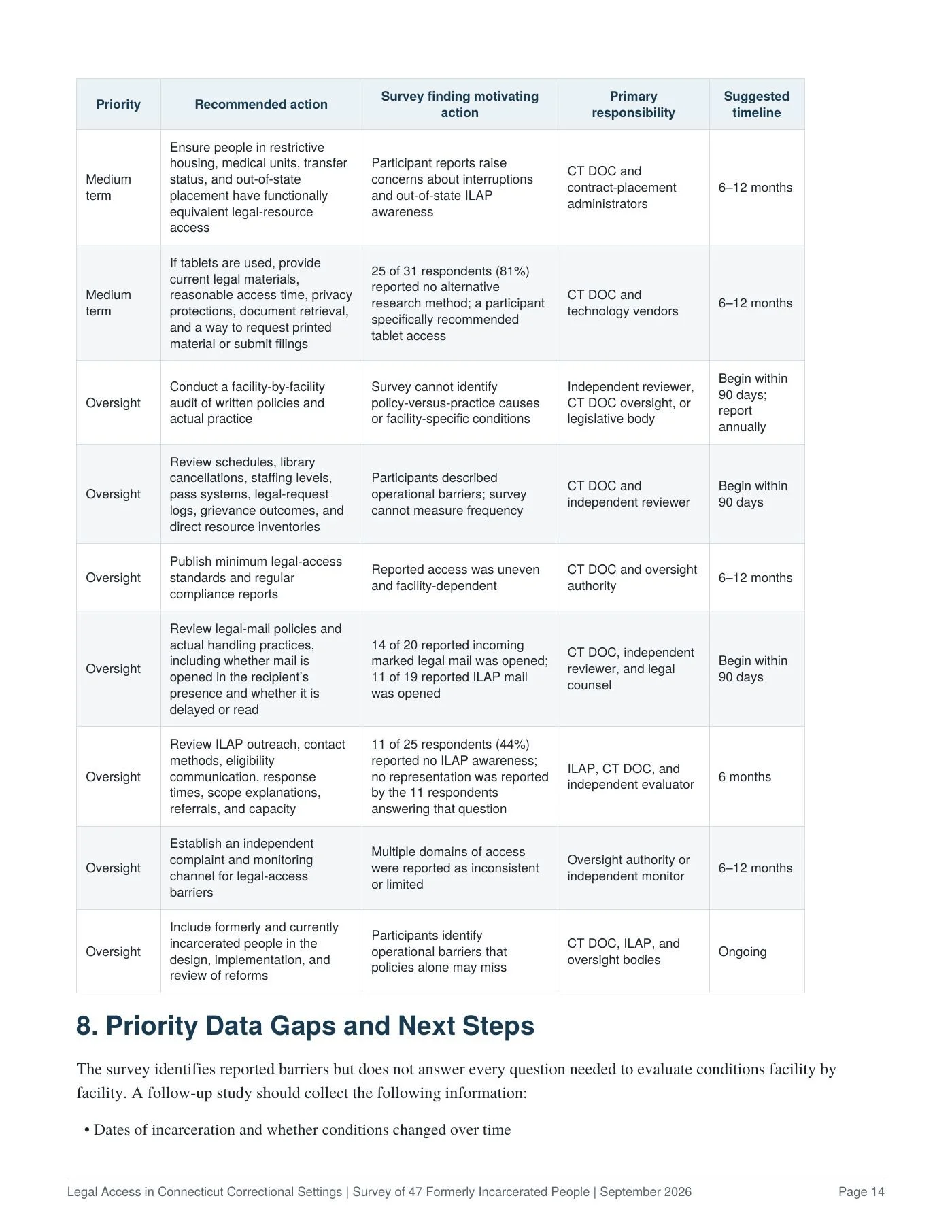
Medium-term steps, within 6 to 12 months.
| Action | Why | Who | When |
|---|---|---|---|
| Secure computerized legal research, or an equivalent regularly updated digital system, at every Connecticut facility | 0 of 31 reported computerized legal research in a Connecticut law library | CT DOC central administration | 6–12 months |
| Make sure resources include Connecticut statutes, the Practice Book, appellate decisions, federal rules, self-help materials and forms | Only a minority reported access to each type of material | CT DOC and legal-resource providers | 6–12 months |
| Printing, or a free or low-cost way to get legal authorities and forms | 0 of 31 reported a printer in a Connecticut law library | CT DOC | 6–12 months |
| Current printed backups where digital systems are down or out of reach | Participants reported outdated or unavailable materials; digital systems can fail | CT DOC | 6–12 months |
| Trained legal-resource staff who can explain procedures and research tools without giving unauthorized legal advice | 3 of 31 (about 10%) reported a librarian or other help | CT DOC | 6–12 months |
| Equal access for people in restrictive housing, medical units, transfer status and out-of-state placement | Reports of interrupted access, and no ILAP awareness out of state | CT DOC and contract-placement administrators | 6–12 months |
| If tablets are used: current legal materials, reasonable time, privacy, document retrieval, and a way to request printouts or submit filings | 25 of 31 had no alternative way to research; a participant asked for tablet access | CT DOC and technology vendors | 6–12 months |
Oversight steps, beginning within 90 days to a year.
| Action | Why | Who | When |
|---|---|---|---|
| A facility-by-facility audit of written policy against actual practice | The survey cannot tell policy from practice or pin down facility conditions | An independent reviewer, CT DOC oversight or a legislative body | Begin within 90 days; report yearly |
| Review schedules, library cancellations, staffing, pass systems, legal-request logs, grievance outcomes and resource inventories | Participants described operational barriers the survey cannot count | CT DOC and an independent reviewer | Begin within 90 days |
| Publish minimum legal-access standards and regular compliance reports | Reported access was uneven and depended on the facility | CT DOC and an oversight authority | 6–12 months |
| Review legal-mail policy and practice, including whether mail is opened in the person's presence, delayed or read | 14 of 20 reported legal mail opened; 11 of 19 reported ILAP mail opened | CT DOC, an independent reviewer and legal counsel | Begin within 90 days |
| Review ILAP outreach, contact methods, eligibility, response times, scope, referrals and capacity | 11 of 25 (44%) did not know ILAP; none of 11 answering reported representation | ILAP, CT DOC and an independent evaluator | 6 months |
| An independent complaint and monitoring channel for legal-access barriers | Many parts of access were reported as limited or inconsistent | An oversight authority or independent monitor | 6–12 months |
| Include formerly and currently incarcerated people in designing, carrying out and reviewing reforms | Participants see operational barriers that policies alone miss | CT DOC, ILAP and oversight bodies | Ongoing |
The field guide suggests where to start, depending on who is in the room.
Start with the lived reality: nobody should need family money, luck or inside information just to find legal materials, get documents or send legal mail.
Start with the action plan: orientation, clear procedures, updated resources, supplies, data collection and independent review.
Start with consistency: a chance to compare written policy with actual practice, reduce confusion, and make access clearer and more reliable.
Start with the open questions: legal-mail handling, access-to-courts evidence, ILAP outreach, out-of-state placement, records and conditions that need fact development.
Start with one verified number, then translate it: a room called a law library does not help if people cannot reach it, research current law, make copies or send a filing.
Whoever you talk to, end by asking for something concrete:
